


Gambia’s “Never Again” pledge has faced its most serious test to date following the dramatic acquittal and subsequent rearrest of Ousainou and Amie Bojang. Beginning as a human tragedy involving a double murder, this saga has developed into a struggle for judicial independence, executive authority, and the resolve of the Gambian citizenry.
The Timeline: From Tragedy to Judicial Resolution
The saga started on September 12, 2023, when two Police Intervention Unit (PIU) officers, Sang J. Gomez and Pateh Jallow, were killed in a shooting incident at Sukuta-Jabang traffic lights. Ousainou Bojang was apprehended soon after, with the State accusing him of fleeing to Senegal with the assistance of his sister, Amie Bojang.
After more than two years of pre-trial detention at Mile 2 Central Prison, the trial was concluded on March 30, 2026, when a landmark judgment was delivered by Justice Ebrima Jaiteh of the Banjul High Court, discharging and acquitting Ousainou and Amie Bojang on all charges.

The Verdict: Why the State’s Case Collapsed
Justice Jaiteh’s verdict was a thorough dissection of a prosecution largely based on circumstantial evidence and confessional testimony, which was later discredited. The prosecution, in its case, had several glaring flaws, including:
- Failure of Forensic Science: The State failed to present any DNA evidence, fingerprints on the murder gun, and gunshot residue linking Ousainou to the murder.
- The “Shoe” Evidence Discrepancy: This was one of those dramatic moments that captured the nation’s attention when the prosecution presented what they believed to be the shoes worn by the murderer during the shooting. However, when Ousainou was asked to wear them in court, they did not fit, a discrepancy that, in the judge’s words, had “profound” implications for the prosecution.
- Contradictory Eye-Witnesses: The prosecution and prosecution witnesses were sharply divided on the height of the murderer, clothing, and even the type of firearm used in the murder. One prosecution witness admitted that her identification of the defendant was partly based on seeing his picture on social media before seeing him in a line-up.
- The Digital Alibi: The prosecution, in its attempt to prove Ousainou’s guilt, overlooked what the judge believed to be conclusive evidence, namely, WhatsApp call records and GPS location data showing Ousainou was at his place of work in Brufut when the murder took place. The defense’s provision of this material evidence to prove otherwise was too strong.
The Rearrest and the April 1st Release
The victory for the defense was, however, immediately followed by executive action. Within 24 hours of the “release and discharge,” the Bojang siblings were rearrested by the Police Anti-Crime Unit. The State filed an urgent appeal and a motion for a “stay of execution,” seeking to keep the siblings in custody.
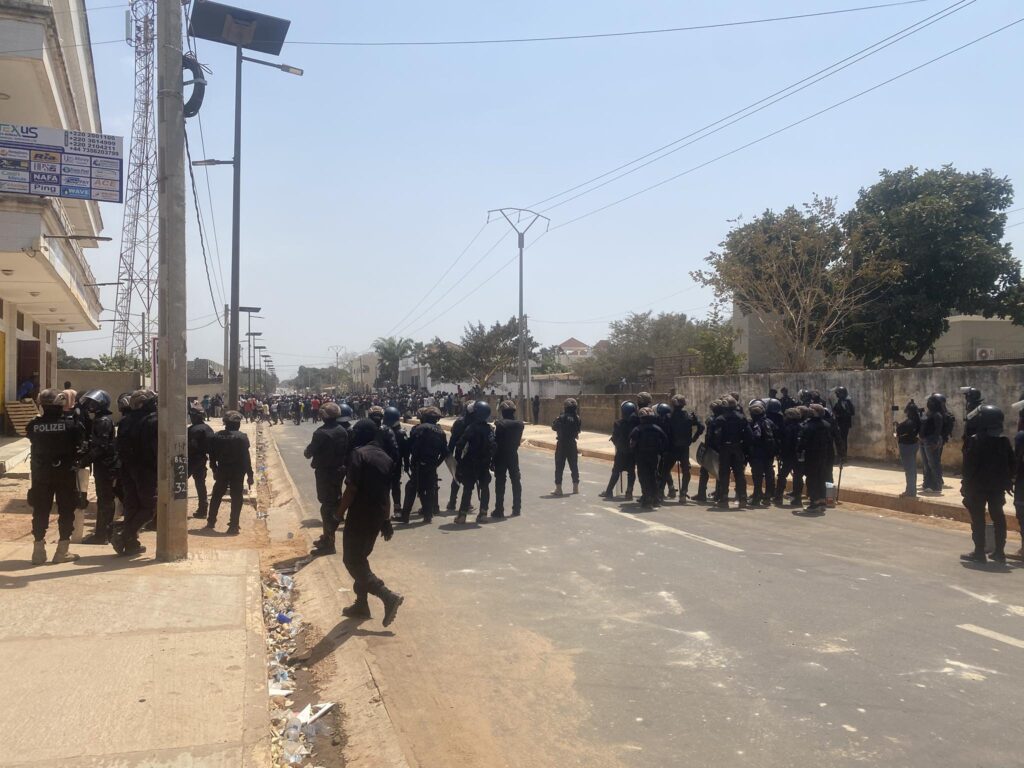
The rearrest sparked a chain of civil unrest. On April 1, 2026, violent protests broke out in Brufut and other areas within the Greater Banjul Area. The protesters clashed with anti-riot police, citing the rearrest as a move to bring back the “Jammeh-era.” As the authorities faced growing pressure and the High Court refused to grant a continued remand without new evidence, they finally processed the siblings’ release on April 1, 2026, on a D50,000 bail bond pending the outcome of the appeal.
Legal Analysis: A Constitutional Litmus Test
In an obvious violation of the siblings’ rights, who have already been acquitted, the State’s actions appear to contravene the provisions of the 1997 Constitution of The Gambia. These provisions are as follows:
- Protection against Double Jeopardy (Section 24[6]): The Constitution is very clear on this provision. No person acquitted by a competent court shall again be tried or detained for the same offense. Legal experts have opined that the siblings’ rearrest for the “same facts” is an attempt to circumvent this provision.
- The Right to Personal Liberty (Section 19): Justice Jaiteh was very clear in his judgment when he noted that once the “presumption of innocence” is established in court, the State must show an incredibly high level of proof, which was not shown in this case (The Voice, 2026).
- Independence of the Judiciary (Section 120): By failing to comply with the order to discharge the accused, the State is fostering an environment of “rule by decree,” where court orders are mere suggestions.
While the State continues to pursue an appeal, the release of the Bojangs on April 1st stands as a significant, albeit fragile, victory for the independence of the Gambian bench.
For a graphic illustration version of the explainer, please visit https://youtu.be/HOn2oHVQZdU?si=hLjZ1rL0_pPH7XSl